Showing posts with label Derm corner. Show all posts

Monday, July 23, 2012

Derm corner: the hair shaft

Wow I feel like an old dusty book writing this post. I bet u didn't think books had feelings....well they actually don't just incase you were second guessing yourself... :)
Anyways, I remembered my promise to post at least once a week and I was going to post last week but was away having fun in Cork for the weekend. If you havn't been you soo have to go. Its the second largest city in th republic of Ireland (and yes it has a funny name) but it's a real cool city. I think I prefer it to Dublin. I love the layout of the city...it's oozes britishness and for any one who knows me, I tend to love all things british in comparison.... Its also a very hilly city so the landscapes are just amazing.  And the people, the so called Corkonians, they are known to be very friendly people indeed. So ya, that's what I've been up to.

It's also a friends wedding this weekend and I'm planning on getting my hair straightened for hopefully the second and final time this year...and this time I'll defo be going to the brazilian salon to get it done. Can I just say that brazilians can dance...I know random to throw that in there, but my...they are real good. I tend to spend more time nowadays watching than actually dancing at the salsa nights...

Ok "re-calculating" (like the GPS woman says)...i'm having a bit of verbal diarrhea tonight largely cos I didn't get out of work till 7:30pm today and secondly cos I treated my self to some thai food +/- white wine as compensation.

Anyways so back to Derm corner...you are very welcome..pls take a seat as I continue from where I left of......... the hair shaft .........
The hair shaft is comprised of 3 layers: the outer cuticle, the inner cortex and the innermost medulla.


1. The CUTICLE- the cuticle covers the cortex...kinnda like a scales on a reptile or tiles on roofing sheets.

Roofing scales

It is basically a thin layer of cells, which may consist of as many as 5-12 sheaths. Each layer is actually anchored to the cortex below and not just simply floating in mid air. 
Interestingly,  the numbers of layers reduces from root to tip, such that at the root you can have about eleven overlapping sheaths forming one layer and at the tip about 5 or less sheaths. Likewise, with thicker stranded hairs, one tends to have more overlapping layers than thinner stranded hairs.

the real deal

The hair cuticle is the first line of defense against all forms of damage. It acts as a protective barrier for the softer inner structure (including the medulla and cortex), and is responsible for much of the mechanical strength of the hair fiber. Interestingly, the cuticle also controls the water content of the fiber, such that when it is open or raised, water entry is permitted and when closed or flat, the opposite occurs.

Y'all will probably notice that I have more information written about the cuticle than any of the other layers and this is because the condition of the cuticle determines the appearance of hair in general. Tattered, worn out cuticles reflect light poorly and the raised cuticle layers rub against each other causing friction thus preventing the hair from moving well. Much of the shine that makes healthy hair so attractive is due to the cuticle. 

In addition, Relaxers, hair dyes and some shampoos can wear away the hair's protective cuticle layers (hence why ingredient reading is so important...which we'll get to in a later post). In fact, the cuticle can get so damaged especially at the tip such that the cortex becomes fully exposed. Below are some pictures of what a damaged cuticle looks like.

Ewwwww


And you thought that was bad

Interestingly, the cuticle  is colorless; This is because it contains no melanin. The hair color we see is actually the pigmentation found in the cortex. 
Ok I think that's enough cuticle talk for one day. Moving on quickly to the next layer.


2. The CORTEX: This is the main part of the hair fibre, accounting for approx 90% of the total weight of the hair shaft. It contains spindle shaped cells made of protein and is responsible for giving hair its elasticity and curl.


3. The MEDULLA:  This is the innermost, central core of the hair shaft..kinnda like an apple core. It contains special cells that are filled with air and may or may not be present in some types of hair.It is mostly seen in terminal hairs and it's function isn't very clear.


Anyways, thats all for now folks...I'm almost dozing off.

Take care ,
XOXO
Miss Jay


References:
Pics- Google images
Text- Dermatology lecture notes by Graham brown and Tony Burns
          Clinical dermatology by Richard Weller, John Hunter, John Savin and Mark Dahl
          The science of black hair by Audrey Davis-Sivasothy
          Wikipedia

Wednesday, May 30, 2012

Derm Corner: Types of hair (geek alert ;)

Seeing that I'm in geek mode, I thought it would be quite a good idea to inform yous about the different types of hair that we see all over our bodies. I don't know about you but I definitely wasn't aware that we had 3 types of hair.


So the 3 types of hair are:
1. LANUGO hair- I know weird name; anywayz, these are fine, soft hairs present when we are in our mothers uterus. Remember how I spoke about the genesis of hair and how when we clock 9 weeks of age we develop our first follicles and hairs?? Well this is the type of hair that grows out of those follicles.
I don't know if you've ever seen pictures of babies in the uterus?- If you look closely, you'll see these tiny hairs sticking out of their bodies as though they were little furry creatures.
Now if you look around your body you wouldn't be able to find any (unless you're anorexic), and that's because, by 8 months of age, you shed all your 'lanugo' hairs. So when next your carrying a baby, look at their skin to spot these fine, soft, lanugo hairs.
About the anorexic reference, apparently these people tend to regrow these hairs again for reasons unknown. So if you happen to be standing next to an anorexic person say on the tube or subway, try and take a peek without being too obvious to see if you can spot them. Better still you could always just google to find images.
I wouldn't recommend starving yourself so that you could show off your new lanugo hairs at the next birthday bash.


lanugo


2. VELLUS hair- This is the fine, short downy hair that covers most of our body. I suppose it's also interesting to note that this hair type does not have a core / medulla (will explain the components of the hair strand in next post).

3. TERMINAL hair- Yes, finally the hair all we hair enthusiasts go ga ga about. This is the thick long hair that is seen in the scalp, eyebrows and eyelashes. Interestingly after puberty, vellus hair develops into terminal hair in the pubic regions,  trunk and arms and legs in real hairy men. In balding the opposite occurs where terminal hair on the scalp becomes vellus hair.

Since we don't care about the hairs on our arms or backs aka vellus hair, I'm going to go straight ahead to explain the structure of the hair strand that grows on our lovely heads.
Stay tuned :)


xoxo
Miss J

Wednesday, May 2, 2012

Derm corner- How hair gets its color

So the last time we stopped at how the actual hair strand is produced from the  matrix and travels up the hair follicle until it reaches the scalp where it becomes visible to the naked eye.

Today we are gonna talk about how and why we get different hair colors.


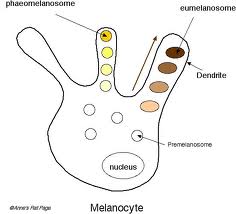
I'm sure you all have heard of the word melanin. It is the pigment that gives skin and hair its natural color. Those with darker skin have higher amounts of melanin than those with fairer skin. This pigmentary substance, melanin, is produced by cells called melanocytes which are located in the cells lining the hair matrix.
[These melanocytes are also found in the border between the epidermis and dermis (the basement membrane) where they produce melanin that gives skin its color.]

Ok, so back to hair- The melanocytes in the hair matrix  are responsible for laying down pigment onto the newly formed hairs. So if you can imagine, as the matrix is producing a colorless hair strand, the melanocytes there quickly slash some melanin onto the hair strand to give it some color.


Now there are 2 types of melanin, and this is what makes ALL the difference:
1. EUmelanin- which is responsible for brown and black hair, and
2. PHAEOmelanin- for red, auburn and blond hair.


Grey and white hair is caused by low melanin production which is mostly due to aging.


GEEK ALERT!!!!

Interestingly, africans, indians and caucasians actually have the same number of melanocytes on their basement membranes. The difference lies in how the melanin is produced. 
Now in actual fact these melanocytes don't just spit out the pigment like a blob of paint. We are human beings and so things are a bit more complex and organized. The melanin is usually contained in little packets called melanosomes and its these melanosomes that are 'secreted' from the melanocytes into neighboring 'normal' cells (keratinocytes) which travel up the epidermis and are eventually shed after we've caused them too much wear and tear with our designer clothes and body creams .


In caucasians, the melanosomes are lumped together forming this big blob and as they are transferred to these keratinocytes which travel upwards, the melanosomes break down hence containing less color by the time they reach the surface.
In darker skinned individuals, the melanosomes are not lumped into one big blob but are individual and larger, and so they travel up the epidermis without being broken down. Pretty cool, huh?

Now this is even cooler; melanosomes within keratinocytes of Asian skin are distributed as a combination of individual and clustered melanosomes with a proportion of 62.6% vs. 37.4%, respectively. This contrasts with dark and light skin keratinocytes where melanosomes are predominantly individual (88.9%) and clustered (84.5%), respectively [Br J Dermatol. 2003 Sep;149(3):498-505]

I'm so tempted to carry on with this topic, as I came across some pretty cool research whilst writing this post. To find out why albinos look the way they do and their melanosome distribution click here

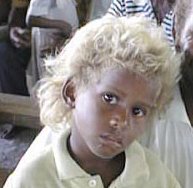
I also found an article that discussed briefly why some australian aborigines, like this kid have blond hair.


That's all for now folks. Hope y'all learnt something new; I definitely did :)

xoxo
Miss Jay

Wednesday, April 25, 2012

Derm corner- How it all began

I don't know about you but I love knowing the genesis of every story. It makes life so much easier knowing how things started because it helps to understand why things work the way they do. In high school I loved biology of all the sciences simply because it made sense. You could often see the cells your teacher spoke about using a microscope in sharp contrast to physics where you could only imagine these electrons, positrons and what not (and that's even if they really existed).
Today we are going to discuss how the hair we see on our skin came about. So sit back and tantalize your brain cells :)

I think it's fair to state before I start that our skin is made up of two layers, the epidermis and the dermis.

*   *   *

As a fetus in your mother's womb you were hairless...like completely bald all over. Your skin was plain and smooth with no tiny black dots on it. Weird huh? Well I have good news. All that changed when you hit 9 weeks of age....9 weeks??....Yes, 9 weeks. I'm gonna get a lil detailed here so hang on.

A cylinder of cells from the surface of your skin grows obliquely downwards from the epidermis into the dermis...kind of like a badger burrowing into the soil. This hollow path created through the thickness of your skin is the famed hair follicle.


Upon getting to the dermis, the follicle is met by another cluster of cells, the placode,  which bulge into the lower part of the hair follicle forming the papilla (the pink stuff). The roof of the papilla and the adjacent concave part of the hair follicle is called the hair matrix.


This papilla would eventually contain blood vessels which bring nutrients to the hair matrix. Since the matrix receives all the goodies that is where mitosis (the rapid division of cells) takes place to form the hair shaft/strand/fibre....whatever you want to call it.


the 'real' deal :)


So basically, the hair you see on your head is as a result of hair fibres, formed by the matrix, being pushed up through the pathway called the follicle.

MYTH BUSTER: So if there is any myth we can debunk with knowing this fact, it is that shaving does NOT make your hair grow faster because all you're doing is just cutting the ends of the hair shaft. It does not affect the matrix in any way and as we have seen, hair growth starts from the matrix in the dermis and not just merely the scalp.

I hope y'all enjoyed the 'pilot'.

Take care and keep watching this space.

Xoxo
Miss Jay

Tuesday, April 24, 2012

Introducing 'DERM CORNER'

lalala
........ YOUR HAIR!!!!!!!!

So I've been wanting to get my 'geek' on but have been procrastinating for a while now. I figured that since I'm 2 years old, I should grow up and talk about hair more in-depth.

I must confess though, there were 3 trains of thought holding me back.
1. There are a gazillion blogs that talk about hair, its science, products to use etc; so I was thinking, why bother and do whats already been done? After all I could always refer people to those blogs!!
2. I also realize that I'm one who likes to get the general gist of things as opposed to being bogged down with nitty-gritty details; Co-incidentally, I happen to be a perfectionist and know that if I started blogging on certain hair topics, I'd have to source out the in-depth information that I tend to scan through.
3. I personally like to look at pictures rather than texts when I look at a blog so I thought it would be boring having all this information.

But then I realized....
1. Teaching people what you've learnt not only solidifies your knowledge but also helps you learn more, as people are bound to ask questions.
2. There is such a huge lack of scientific knowledge about hair in our society; people often go on 'she said' 'he said'; and so I hope that people may be more willing to listen especially since it's coming from one of their own.
3. People like my sis who are so not into hair would be able to get info from my blog which they'd otherwise not seek out (and hopefully with that info I can sway them into becoming natural...mwahahahahaha!!!!)
 4. Also, giving that I have a science background, I may be in a good position to give factual information with the resources at my disposal. (I'm gonna have to put my research hat on....boy, this is gonna be hard work...lol). But you know what how cool would it be to be able to use the information gathered in both a professional and social setting??

My goal for this 'corner' is to talk about hair from both a dermatological and cosmetic view point.
For those who don't like to read so much text, I'll have a 'Did you know that...." section with short and sweet bullet points.
I'd also like to make this section as picture heavy as possible to make reading and understanding easier. (I don't know about you but I'm a visual learner).

Hope ye all enjoy it and learn loads....I'd be doing some learning too for y'all ;)

I'll be posting soon so watch this space !!!!!!.

XoXo
Miss Jay

-